Open source · Agent-native EDA

Build circuits
with your
coding agent.

PCBoo turns a project folder into a complete circuit workspace. Compose boards in TypeScript, ask your existing agent to edit them, and inspect every result in the browser.

01Initial release targetApple Silicon macOS
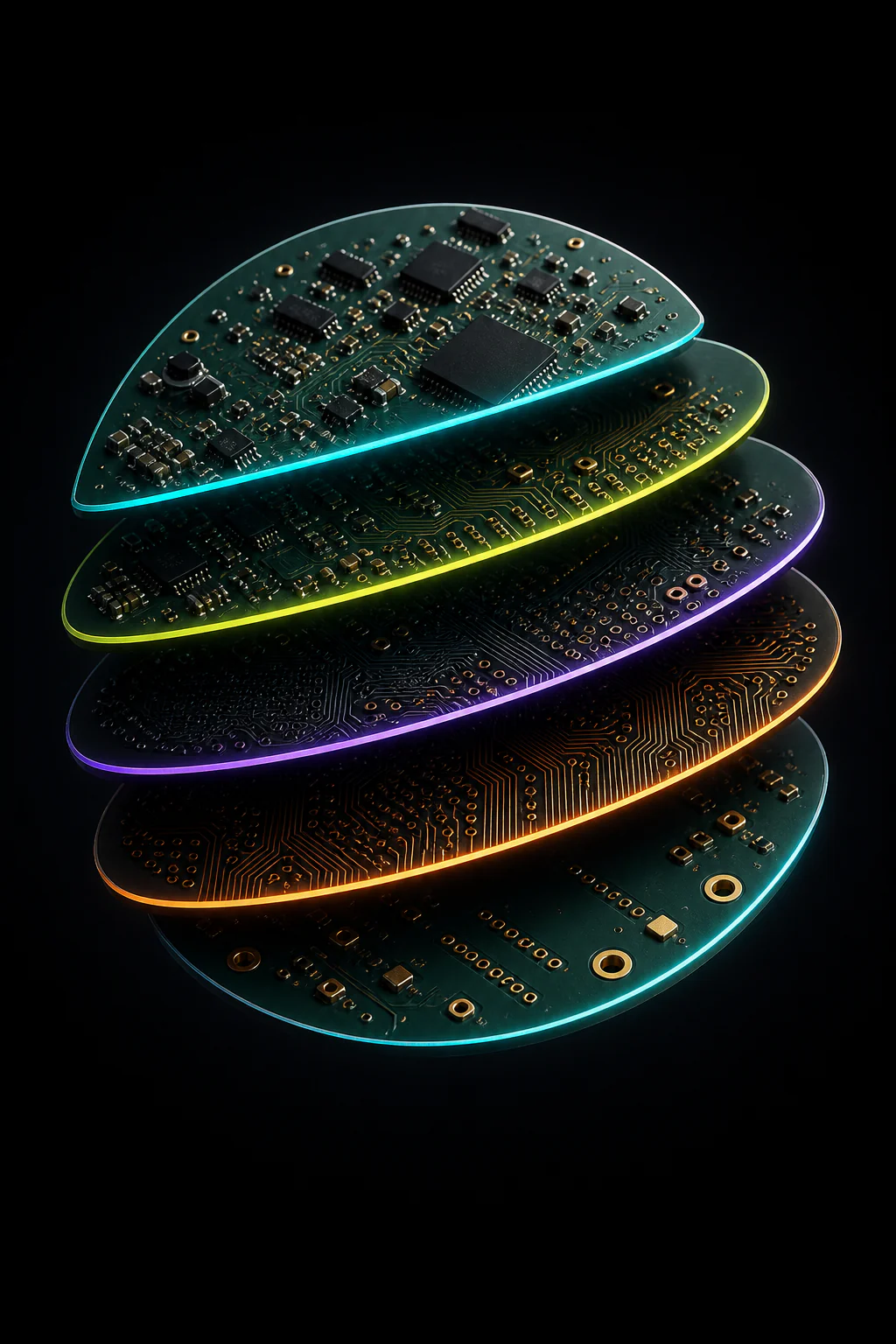
Five illuminated slices revealing the physical layers of a detailed circuit board
PCB-01 / FOUR-LAYER SYSTEM BUILD PASSED
SOURCETypeScript
OUTPUT4 layers
CHECKS Verified
01 / THE IDEA

The repository is the interface.

Hardware deserves the same composable, inspectable workflow as software.

PCBoo is not another visual editor and not another agent runtime. It gives coding agents a precise filesystem contract, deterministic commands, and compact results they can reason about.

Humans stay in the loop through a local inspection server—and can hand off to KiCad when fine manual adjustment is the right tool.

02 / WORKFLOW

From prompt to
production evidence.

One project. Normal files. A small set of commands that agents can run, inspect, and repair without a proprietary UI.

01
my-board/
circuit/
TS board.ts
TS power.ts
tests/
pcboo.config.ts
pcboo.lock
COMPOSE

Circuits are normal TypeScript.

Split the board into small, named components. Import and combine them just like application code.

02
import { Board, Circuit } from "pcboo";
import { addPower } from "./power";

export default function createCircuit() {
  const circuit = new Circuit();
  const board = new Board({
    width: "30mm", height: "20mm",
    layers: 4
  });
  addPower(board);
  circuit.add(board);
  return circuit;
}
AUTHOR

Your agent edits the source.

Use Codex, Claude Code, Cursor, or any filesystem-capable coding agent. No special chat surface required.

03
$ bun run pcboo build
$ bun run pcboo check
$ bun run pcboo dev
VERIFY

Build, test, inspect, repeat.

Get concise diagnostics for the agent and visual board, schematic, layer, and measurement views for the human.

03 / EVIDENCE, NOT PROMISES

Every status
stays honest.

PCBoo keeps independent validation dimensions separate. A manufacturable layout never silently implies a passing simulation, available parts, or standards compliance.

  • 01 Deterministic repeat builds
  • 02 Versioned, machine-readable reports
  • 03 Draft artifacts cannot masquerade as verified
  • 04 No telemetry or project upload by default
RUN / 7F3A9CBOARD REVISION A
Fabrication
PASSED
Electrical
PASSED
Functional
INCOMPLETE
Standards
PROFILE ONLY
Sourcing
UNAVAILABLE
!

Passing one dimension never changes another. Unavailable work remains visible in reports and manifests.

04 / SYSTEM SURFACE

Small interface.
Deep verification.

BUILD

Deterministic compilation

Compile twice, normalize Circuit JSON, and detect ordinary nondeterminism or undeclared inputs.

01 ↗
INSPECT

Local visual workspace

Pan, zoom, filter layers, select geometry, measure, and trigger bounded derived actions from loopback.

02 ↗
SIMULATE

Qualified ngspice runs

Named testbenches, explicit models, bounded solver execution, and independent numeric assertions.

03 ↗
EXPORT

KiCad handoff

Create a detached, validated KiCad project for the moments when manual CAD adjustment is valuable.

04 ↗
MANUFACTURE

Verified artifacts

Generate and independently reconcile Gerber, drill, BOM, and placement evidence before promotion.

05 ↗
05 / OPEN FOUNDATION

Built in public.
Built on tscircuit.

PCBoo is an independent MIT-licensed project. It reuses tscircuit’s circuit authoring and compilation ecosystem while adding an agent-first project contract, verification boundaries, local inspection, and production-evidence workflow.

PCBoo is not an official tscircuit product and does not imply endorsement by or affiliation with tscircuit Inc. Third-party packages and assets retain their own licenses.

Read the source on GitHub
READY WHEN THE PACKAGES ARE

Describe the board.
Let the agent build.

Follow development, inspect the architecture, and help shape an open circuit workflow made for coding agents.

Star PCBoo on GitHub